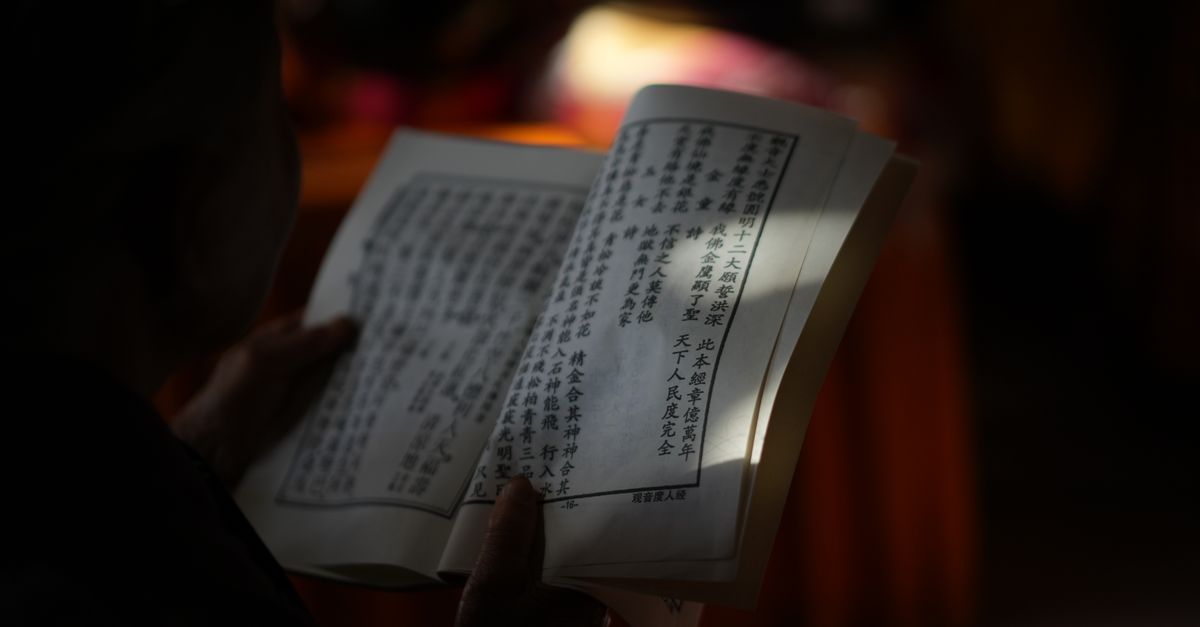
Reading Chinese is one of the most demanding literacy tasks an adult English speaker can take on. Chinese is logographic: every character is its own visual unit you memorize on sight, with almost no phonetic clue to sound it out, and comfortable newspaper reading takes 2,500 characters or more. The U.S. Foreign Service Institute files Mandarin in its hardest bracket, Category V, at roughly 2,200 hours of study to reach professional proficiency.
I have watched a lot of smart, motivated adults hit the same wall. They get a few hundred characters in, feel the momentum, then open a real page of Chinese and the floor drops out. The words run together with no spaces. Half the characters look like cousins of ones they already recognize, and nothing on the page tells them how to pronounce the new ones. Everyone hits that wall, fluent native readers included. The writing system is what makes the page so steep, and it does the same thing to a Beijing ten-year-old.
Why is reading Chinese harder than speaking it?
Reading lags behind speaking because the script gives you no alphabet to fall back on. In Spanish or French, once you know the sounds, you can read a new word aloud and often guess its meaning. Chinese breaks that bridge. Characters carry meaning as shapes, and most offer no reliable cue to their sound, so spoken fluency does not automatically unlock the page.
There is a second tax most learners never see coming. Chinese text has no spaces between words, so a reader has to segment where one word ends and the next begins while also decoding each character, two jobs at once that an English reader gets for free. Hao and colleagues, writing in Frontiers in Psychology in 2022, found that decoding accuracy predicted reading comprehension at every proficiency level among adult learners of Chinese, and the missing word boundaries are part of why. Research on beginning readers points the same way: visual discrimination, the knack for telling near-identical shapes apart, was the standout kindergarten predictor of first-grade character reading. Reading Chinese is a visual skill before it is anything else.
How many characters do you actually need?
You need roughly 2,500 characters to read a newspaper without constant lookups. The 1,000 most common characters cover about 90% of what appears on a modern page, and 2,000 push you past 97%, but that last stretch is where the meaning often hides. Reading novels comfortably can demand more still.
| Characters known | Approx. text coverage |
|---|---|
| 1,000 | about 90% |
| 2,000 | over 97% |
| 3,500 | about 99.5% |
| 4,000 to 5,000+ | fiction and specialized texts |
Coverage figures come from the Wenlin Institute's frequency statistics and a frequency analysis of real Chinese texts published on Sinosplice. The percentages flatter the difficulty. Ninety-seven percent coverage sounds like an A, until you notice the missing 3% lands on the exact words that carry the point. David Moser, an associate professor of Chinese linguistics at Capital Normal University in Beijing, said it plainly: "I couldn't comfortably read a newspaper when I had 2,000 characters under my belt. I often had to look up several characters per line, and even after that I had trouble pulling the meaning out of the article." Single-character counts also undersell the work, because those characters pair up into multi-character words you have to learn as their own units.
How long does it take to learn to read Chinese?
Plan on years, not months. The FSI's 2,200-hour estimate covers broad professional proficiency, and reading is the slowest of the four skills to mature. Native Chinese children, who already speak the language fluently, take an estimated seven to eight years to learn to read and write 3,000 characters, about twice as long as children on alphabetic scripts reach comparable literacy.
That native-speaker number is the one that recalibrates people. As Moser relays it: "John DeFrancis, in his book The Chinese Language: Fact and Fantasy, reports that his Chinese colleagues estimate it takes seven to eight years for a Mandarin speaker to learn to read and write three thousand characters." These are kids who already own every word by ear. The bottleneck is the characters themselves. Even fluent, highly literate adults regularly blank on how to write common words they read without trouble, which tells you how heavy the memory load runs and how little the script does to carry it for you.
Is there an efficient path through the difficulty?
Yes. Characters follow a steep frequency curve, so the top 2,000 to 2,500 of them show up in 97% to 99% of everyday text, which means focused high-frequency study pays back quickly and compounds. The road is long, but it is not random, and early effort buys outsized reading ability.
Front-load the common characters and you feel returns within weeks instead of years. The other lever is owning the spoken word first. When you already know a word by sound and meaning, learning its character becomes attaching a face to a name you know rather than memorizing a stranger cold. That is the argument for building real spoken fluency alongside the reading, and it is why an app like Watch Your Tones, which drills conversation and corrects your tones syllable by syllable, makes the characters land easier when you finally meet them on the page. The reading is hard. It is also finite, frequency-ranked, and beatable with the right order of operations.
Frequently asked questions
How long will it take to learn to read Chinese?
Plan in years, not months. The U.S. Foreign Service Institute estimates about 2,200 hours of study for English speakers to reach broad professional proficiency in Mandarin, its hardest category. Native Chinese children, already fluent speakers, take an estimated seven to eight years to read and write 3,000 characters, and reading is the slowest skill to mature.
How many characters do you need to read a Chinese newspaper?
Comfortable newspaper reading typically takes 2,500 characters or more. The 1,000 most common characters cover about 90% of a modern page and 2,000 cover over 97%, but that final few percent often carries the meaning. Reading novels and specialized texts can require 4,000 to 5,000 or more.
What are the hardest languages to learn for English speakers?
The Foreign Service Institute's hardest group, Category V, contains Mandarin Chinese, Arabic, Japanese, and Korean, each requiring roughly 2,200 hours of study for professional proficiency. Mandarin sits at the top end largely because its logographic writing system offers almost no phonetic shortcut to reading.
How do you say 1 to 10 in Chinese?
In Mandarin, one through ten are yi (1), er (2), san (3), si (4), wu (5), liu (6), qi (7), ba (8), jiu (9), and shi (10). They are among the first characters learners pick up because they recur constantly and several have simple forms.
Sources reviewed
- FSI Language Difficulty Rankings
- David Moser, 'Why Chinese Is So Damn Hard' (pinyin.info)
- Wenlin Institute Character Frequency Statistics
- Sinosplice — 'A Realistic Look at the Challenges of Reading Chinese' (Julian Suddaby analysis)
- Hao et al. (2022), 'The Extended Simple View of Reading in Adult Learners of Chinese as a Second Language,' Frontiers in Psychology
- PMC — 'Predictors of Early Mandarin Chinese Character Reading Development'